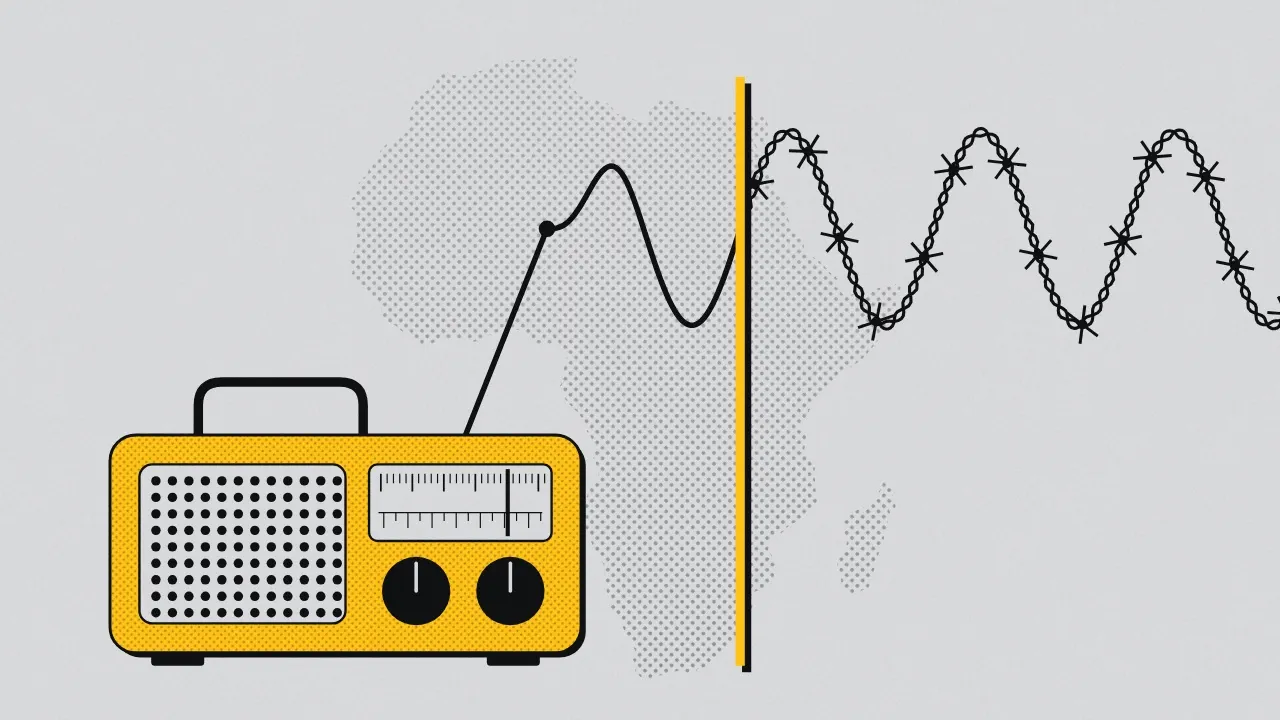
The aggressor state, russia, is building its own media network across Africa. In addition to the familiar “russian houses” and rossotrudnichestvo centres, the aggressor state is opening editorial hubs, negotiating airtime on local radio stations, launching digital platforms, and recruiting local journalists and bloggers.
Behind rhetoric about culture, language, and the “friendship of peoples,” professional propagandists are pushing kremlin narratives: anti-Western and anti-Ukrainian messages, and, above all, attempts to justify russia’s criminal aggression.
Moreover, the kremlin is seeking to dominate radio airwaves across African countries in order to create a favourable information environment for russian recruiters. So-called moscow recruiters continue to lure Africans with promises of jobs and earnings, only to send them into meat-grinder assaults in the war against Ukraine.
Propaganda as the First Stage of Recruitment
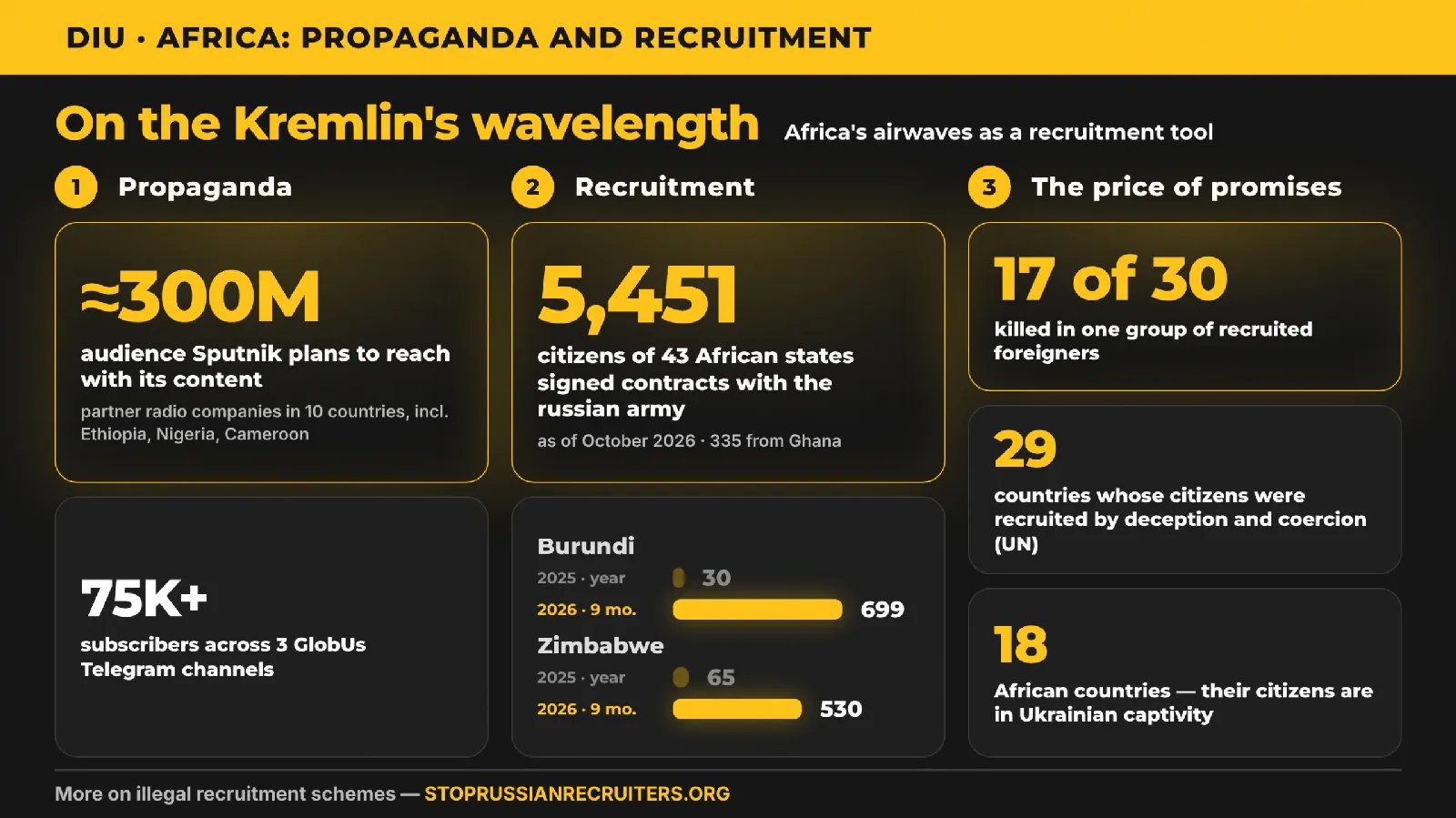
russia’s state news agency Sputnik is expanding its network across the African continent. Its editorial hubs operate in Johannesburg (South Africa) and Dar es Salaam (Tanzania). Through local journalists and partner radio stations, the kremlin plans to distribute content in several languages, reaching an audience of nearly 300 million people. Radio broadcasters in Ethiopia, Botswana, Malawi, Uganda, Nigeria, the Central African Republic, Mali, Niger, Guinea, and Cameroon are being brought into the network.
The content of this information expansion goes beyond news. moscow is promoting narratives about fighting neocolonialism, confronting Western countries, and supposedly defending the sovereignty of African states. In this way, russia is attempting to establish itself as a partner offering an alternative to the Western world, while concealing its own imperial and colonial policies.
Another tool of information interference is the GlobUs digital platform. A report by France’s state agency VIGINUM exposes the activities of this russian influence network, which is linked to former structures associated with yevgeny prigozhin. The network is headed by russian political strategists yulia berg and andrey gromov, who have organized information campaigns, including in Cameroon and the Republic of the Congo.
GlobUs recruits local journalists, bloggers, and political figures to disseminate anti-Ukrainian and anti-Western content. The network operates three Telegram channels with a combined audience of more than 75,000 subscribers. The Vozrozhdeniye Foundation, previously established by andrey gromov, promoted russian narratives about the war against Ukraine, organized trips for foreigners to temporarily occupied territories, and supported the production of propaganda films about Donbas.
Through local media, bloggers, and digital networks, the kremlin is seeking to influence public opinion, discredit Ukraine, and justify its own aggression.
From Job Promises to russian Assault Units
Information influence is only one aspect of russia’s presence on the continent. At the same time, moscow is expanding its recruitment of Africans into its armed forces in an attempt to compensate for its colossal losses in the war against Ukraine.
According to Ukrainian military intelligence, as of October 2026, the personal details of at least 5,451 citizens from 43 African countries who signed contracts with the armed forces of the russian federation have been identified. This includes at least 335 Ghanaian citizens.
The scale of russian recruitment has increased significantly in some African countries. In the first nine months of 2026 alone, russia recruited 699 citizens of Burundi and 530 citizens of Zimbabwe. By comparison, the respective figures for the entire year of 2025 were 30 and 65. This trend indicates a deliberate expansion of recruitment networks in countries where populations are particularly vulnerable to promises of quick earnings.
Recruiters use offers of highly paid civilian jobs, substantial signing bonuses, russian citizenship, and social benefits to attract people. Men are lured with vacancies for drivers, security guards, construction workers, and logistics personnel. They often discover the real purpose of their journey only after arriving in russia. Instead of the promised jobs, they are presented with military contracts written in russian, a language many of them do not understand, and subsequently sent to the front lines in Ukraine.
The Defence Intelligence of Ukraine (DIU) has already published a number of reports detailing russia’s methods of recruiting citizens of African countries and using them in its war against Ukraine. These include the story of Botswana citizen Pako Namogang, who was recruited via WhatsApp, transported to russia, and subsequently sent to the front, where he was killed; an investigation into Kenyan citizens who were transferred to assault units after only brief training; the stories of two recruited Cameroonians, whose bodies were found in different sectors of the front; and information about a mercenary from Sierra Leone who was killed in action. These cases demonstrate the systematic recruitment of foreign nationals into russia’s war of aggression.
The scale of this practice has also been confirmed by the Independent International Commission of Inquiry on Ukraine established by the United Nations. In its findings from the investigation, published on 26 October 2026, the Commission identified compelling evidence of the recruitment of citizens from 29 countries into the russian armed forces through deception and coercion. The aggressor state, russia, coordinated the activities of intermediaries who lured men with fictitious job offers, arranged their travel, and then pressured them into signing military contracts after their arrival. In many cases, the recruits had their passports and phones confiscated, while refusal to sign a contract was met with threats or actual violence.
Foreign Mercenaries Are Disposable Assets for russian Commanders
Recruited foreigners who do not speak russian, often lack proper military training, and do not understand the terms of the contracts they have signed are sent into assault operations on the most dangerous sections of the front.
The UN Commission documented cases in which foreign recruits were sent to the front lines despite written assurances that they would not take part in combat operations. In one group of 30 men, 17 were killed, five went missing, and one returned after being wounded. Investigators also recorded beatings, death threats, and the use of drones to prevent mercenaries from retreating.
The human cost of russian recruitment is becoming increasingly evident in prisoner-of-war statistics as well. According to defence intelligence, dozens of citizens from 18 African countries are already being held in Ukrainian captivity, and their number continues to grow.
Recruitment offers provide foreigners with none of even the most basic guarantees. Intermediaries disappear and stop responding, relatives are unable to obtain information about their loved ones, and promised payments and compensation remain out of reach. Men lured by promises of a better life are treated by russian commanders as disposable assets in assault units.
This is the true cost of russia’s presence in Africa: first, the kremlin seeks to win people's trust through information manipulation; then it exploits their vulnerability to recruit them; and ultimately, it sends them to their deaths.
Under slogans of anti-colonialism and equal cooperation, moscow is reproducing old imperial practices: interfering in the information space of other countries, manipulating their citizens, and exploiting human lives to prolong its criminal war against Ukraine.
For more information about the schemes used by the aggressor state, russia, to carry out illegal recruitment in Africa and other parts of the world, visit the STOPRUSSIANRECRUITERS.ORG platform.